•
Travel Journal
Blog Posts
•
•
•
•
•
Travel Journal

Pin Traveler Blog

Most people start trying to track their travel about a decade too late. You're somewhere around country twenty-five, someone asks how many you've been to, and you realise you're counting on your fingers and getting a different answer each time.
This guide covers the five methods that actually work, what each one costs in money and effort, and — the part most guides skip — how to reconstruct a travel history you never recorded in the first place.
This sounds pedantic. It is the single most common reason people's counts are wrong, and you should settle it before you record anything.
Does an airport layover count? The most widely used standard says no. If you didn't leave the airport, you weren't in the country.
Does a cruise port day count? Contested. Most trackers say yes if you set foot on land.
What about countries that no longer exist, or ones you visited as a child? Your list, your rules — but write the rule down. Consistency matters more than which rule you pick.
Countries or territories? There are 195 UN member states, but definitions range from 193 to 250+ depending on whether you count territories, dependencies and disputed regions. Most apps use their own list. Pick one and stay with it, or your percentage will jump every time you switch tools.
Write your rules in a note before you start. You'll thank yourself in five years.
Cost: free to about $35/year. Effort: low, ongoing.
This is the only method on the list that produces all three things people actually want: a map, a running count, and a record that survives the next twenty years without maintenance.
The apps split into two groups, and choosing the wrong group is the usual mistake:
For "track every country I've visited," you want a destination tracker.
What to look for:
Where it asks something of you: logging is manual. Half a minute per destination, after each trip. Nothing here records travel automatically the way an always-on GPS app does — that's the trade for a record that isn't tied to background location access.
Cost: free. Effort: medium, and it compounds.
Columns for country, city, dates, notes. Total it up. Add a pivot table if you're that way inclined.
Why it works better than people expect: total control over what counts, trivial to export, no subscription, and no company able to change the product or shut it down. If you distrust apps on principle, this is the honest answer.
Why it fails for most people: no map. A list of 63 rows is a fact; a coloured world map is a picture, and the picture is what people actually wanted. Building one from a spreadsheet means manual work in a mapping tool every single time.
Cost: $20–50 once. Effort: almost none.
Physical scratch maps are genuinely delightful and make an excellent gift. Scratch off a country, see the colour appear.
Why it fails: country-level only, lives in one room, and you can't take it with you. No dates, no statistics, no cities behind it. It's an ornament that happens to be accurate — best owned alongside a real record rather than instead of one.
Cost: nothing. Effort: low to start, high to maintain.
The oldest method still works. A page at the back of a notebook, one line per country, with the year.
Why it fails: it doesn't survive. Notebooks get lost, there's no map, and answering "what percentage of the world" means doing arithmetic. It also doesn't handle cities, so a decade of domestic travel disappears.
Cost: free. Effort: none. Status: unreliable as of 2025.
This used to be the honest free answer. If location history was enabled, Google had been quietly logging your movements for years, and you could scroll back through trips you'd forgotten.
What changed: Google discontinued Timeline on the web, moved history from the cloud to your device, and by default retained only the most recent three months — deleting everything older. A separate technical fault in 2025 then erased data belonging to users who had migrated correctly and kept no backup.
What it's still good for: whatever survived is a useful source when reconstructing your history. See the next section. Just don't treat it as the record itself — that's precisely the assumption that cost people years of data.
We covered the full story, including how to recover what's left, in Google Maps Timeline is gone — how to track your travel history now.
This is the hard part, and it's why most people put off starting. You don't have to remember everything at once — you have to find the receipts.
Work through these sources in order. Each one triggers memories the next one confirms:
Then log it all in one sitting. Reconstructing fifteen years of travel takes most people about two hours with these sources open. Do it once, properly, and then maintain it as you go — five minutes after each trip instead of two hours every decade.
For most people: a destination-tracker app, populated in one reconstruction session using the sources above, then updated after each trip. Pin Traveler's free tier is uncapped, so you can complete the whole reconstruction without paying to find out whether you like it.
If you distrust apps: a spreadsheet plus a wall scratch map. Free, durable, yours.
If you want the route and the story: Polarsteps for the trip, a destination tracker for the lifetime map. They're different jobs.
Work through passport stamps, your photo library sorted by location, email booking confirmations, card statements with foreign transactions, and whatever remains in Google Maps Timeline. Between them, most people recover a complete history in about two hours.
A destination-tracker app is the most practical option for most people — it gives you a map, a count and statistics that persist. Logging is manual, but it takes about half a minute per destination. Pin Traveler, Visited and Been are the main choices; Pin Traveler is the only one of the three with an uncapped free tier covering cities, countries and U.S. states.
By the most common standard, no — if you didn't leave the airport, it doesn't count. The rule matters less than applying it consistently.
195 UN member states, but counts range from 193 to over 250 depending on how territories, dependencies and disputed regions are treated. Different apps use different lists, which is why your percentage can change when you switch tools.
Some apps only handle countries. Pin Traveler pins by city, with countries and U.S. states alongside; Visited covers states and national parks; Been is country-level only.
Yes. A spreadsheet costs nothing. Google Maps Timeline is free if location history is on. Pin Traveler's free tier allows unlimited pins without payment.
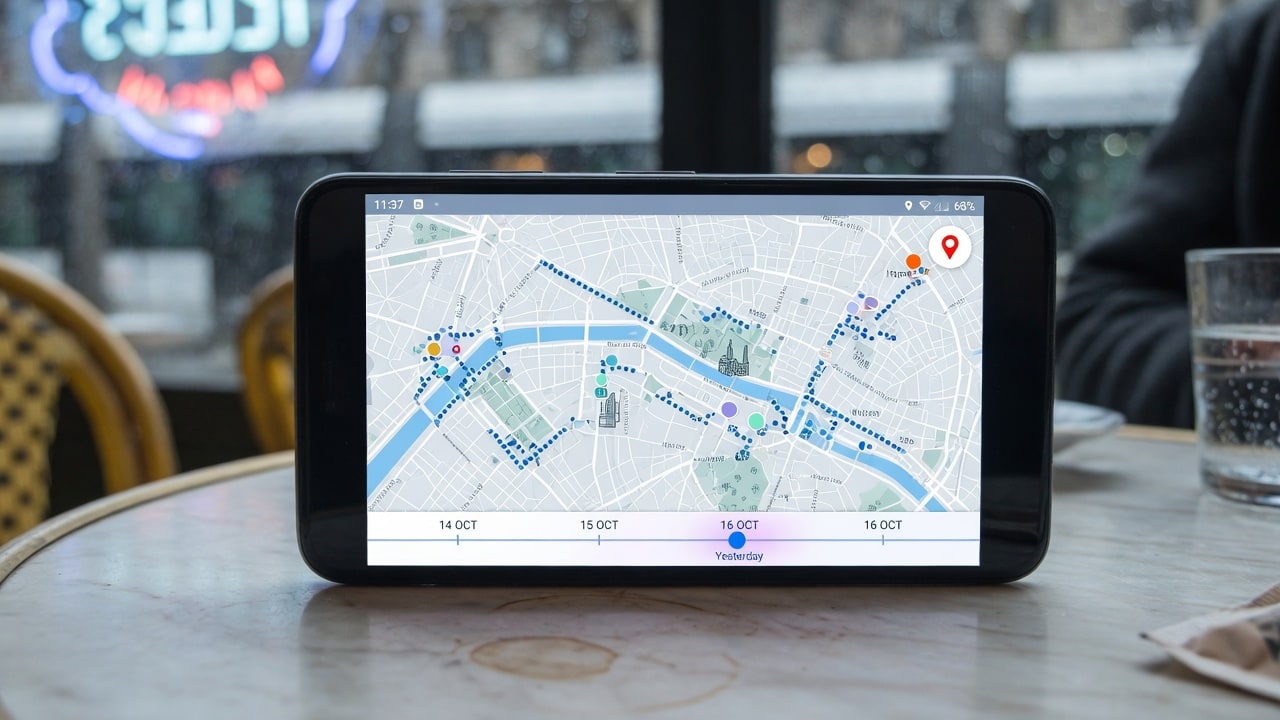
Google killed Timeline on the web, deleted years of location history by default, and lost more of it to a bug. Here's what happened, what you can still recover, and where to keep your travel record instead.
2026-08-04

Nine apps for tracking where you've been, compared on what they actually record, what they cost, and who each one suits. Tested August 2026.
2026-08-04

Nine apps for mapping the U.S. states you've visited, compared by what they record, travel beyond the U.S., free tiers, and pricing. Tested September 2026.
2026-09-15